
.
Kobi Halperin, one of Israel’s most successful fashion designers on the international stage, speaks about his childhood in Netanya, his religious upbringing, his grandmother from Mea Shearim with the red nail polish and high heels, the road from Shenkar to New York and Ungaro, and the power of fashion to bring a woman back to herself
Some designers build a world through cut, color and silhouette. Kobi Halperin builds a world through memory. Through home. Through women. Through that precise moment when a garment stops being an item of clothing and becomes a place where one can breathe. Halperin, born in Netanya and a graduate of Shenkar, has achieved what very few Israeli designers have managed to do. He left Israel, arrived in New York, worked at the heart of the industry, built a name for himself, and then turned that name into an international brand.
For 13 years, he served as Executive Creative Director at the house of Elie Tahari, the New York fashion brand founded by the Israeli American designer Elie Tahari, known for elegant, commercial and highly wearable American womenswear. He then continued for three years at Kenneth Cole Productions, the American fashion brand spanning apparel, footwear and accessories, identified with a distinctly urban New York language and socially conscious campaigns.
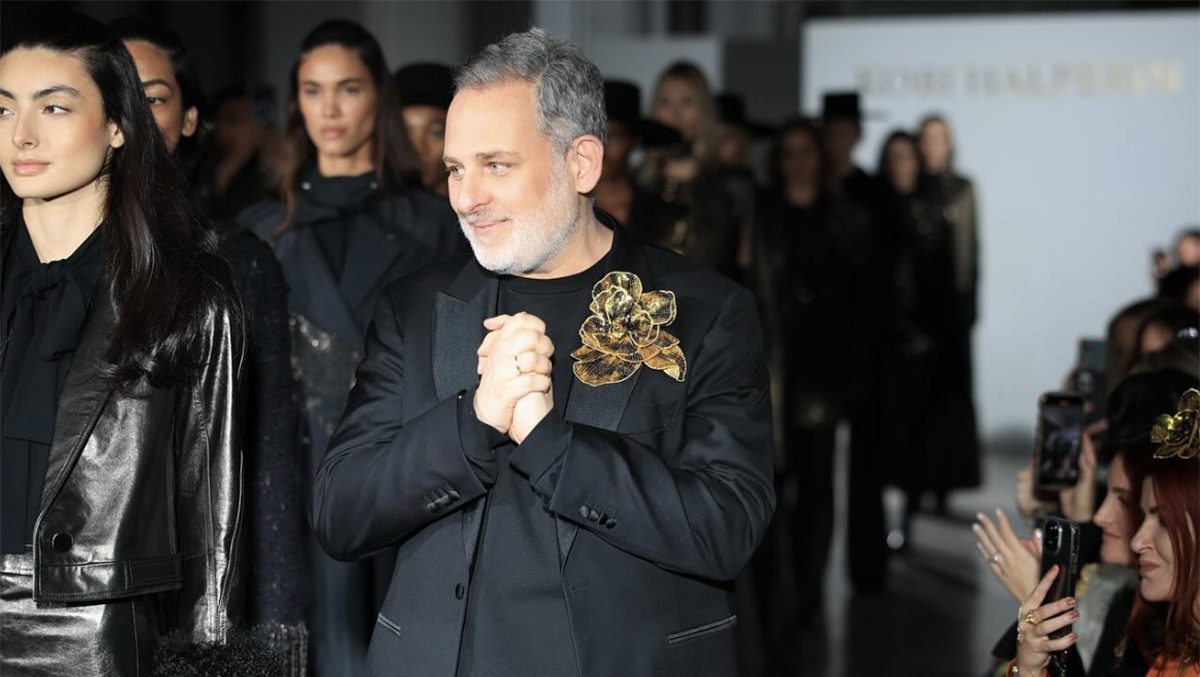
In 2015, he founded the international brand that bears his name, Kobi Halperin. He later joined the CFDA, the Council of Fashion Designers of America, one of the most influential and prestigious institutions in the American fashion industry, bringing together some of the leading names in the field. In 2021, he was appointed Artistic Director of womenswear at the French fashion house Ungaro. A year later, he was honored by Boston Arts Academy as a Fashion Honoree, a recognition that positions him not only as a successful designer, but as a creator with cultural and educational influence.
Yet the résumé, impressive as it is, is only the gateway. The real story of Kobi Halperin begins where Netanya meets Paris. Where modesty meets sensuality. Where a religious home meets international fashion. Where fashion is not an escape from one’s roots, but the way to turn those roots into a language. "I want women to be the best version of themselves."

"I Come from a Home I Would Describe as Royalty"
When I ask Halperin what he sees first when he returns to his childhood, he does not speak of lack, nor of a dream of escape. He speaks of happiness. Not financial happiness, but cultural abundance. "I see a certain kind of happiness," he says. "It had nothing to do with money. It was more cultural richness. I feel I come from a kind of home I would define as royalty. Those are the roots of everything."
That royalty was not made of money. It was made of books, rituals, sacred objects, Shabbat, women who dressed with dignity, and a child who understood very early that beauty was not a luxury. Sometimes it is a language. Sometimes it is a spine. "Even before I knew how to define the word fashion, I had a connection to aesthetics," he says. "As a small child, I would cry to buy something decorative for the house. I was very connected to my mother, to my family, to clothes, to beauty. It was always around me."
Fashion, as a profession, arrived at the age of 12. While preparing for his bar mitzvah, he began sketching fashion drawings for his mother. Then came a meeting with the fashion designer Yehuda Dor in Tel Aviv. There, in the studio, in front of fabrics opening before him, something in him recognized itself. "I remember the fabrics opening," he says. "That was when I understood it could be a profession. Until then, I thought I would go into psychology. Today I feel I deal more with psychology than with fashion." It is a sentence that holds almost all of Kobi Halperin. He does not design merely to dress. He designs to understand. To strengthen. To touch the moment when a woman stands in front of the mirror and asks not only how she looks, but how she feels.
The Grandmother from Mea Shearim, the Red Nail Polish and the Heels
Almost every designer has one figure who opens the eye. For Halperin, it was not one figure, but an entire female lineage. Women of dress, presence, style and strength. Yet the most powerful memory leads him to his paternal grandmother, a deeply religious woman from Mea Shearim, who brought with her from Europe an elegance that refused to surrender, even when life was not simple.
"My whole family is Hungarian," he says. "My grandmother, as a very religious woman in Mea Shearim, had a style I still think about today. It is amazing to think that clothing and style can show a kind of happiness that is not necessarily connected to financial circumstances." He remembers her in slightly sheer dresses, red nail polish, blonde wigs, grandeur and heels. "She passed away at 80 wearing heels," he says.
In that sentence, there is everything. Tradition, femininity, daring, elegance and a refusal to give up on beauty. Not beauty that asks for permission. Beauty that holds body, memory and dignity. Alongside his grandmother, there was, of course, his mother. "Clothing and fashion were, for her, a way to express strength," he says. "Perhaps even then I understood the connection between fashion and power." That is one of the keys to understanding his brand. For Halperin, a garment is not decoration. It is quiet power. Power that arrives through proportion, texture, cut, movement, and a woman’s ability to enter a room and feel herself.

"A Garment Is Part of Preparing Yourself for Something Special"
Halperin grew up in a religious home, but he does not speak about religion from a place of rebellion or distance. He speaks from a place of gratitude. Within an Israeli society that is angry, divided and charged, he chooses to remember the beauty that existed there too.
"There is something in religion that inspires great respect," he says. "I wish I could have taken more from my father. That way of being a simple and good person is something I would be happy to define myself by. I am still trying to become that person." When he speaks about clothing within the religious home, he does not speak of prohibition. He speaks of preparation. Of Shabbat. Of holiness. Of the moment in which a person dresses not in order to impress, but in order to enter another state of mind.
"When you are raised in a religious home, there is respect for the sanctity of Shabbat," he says. "There is an understanding that clothing is part of preparing yourself for something special. I remember Fridays as something very meaningful for me. The connection between dressing, holiness and elegance is something that is in the blood."
Perhaps that is why modesty, for him, takes on another meaning. Not reduction. Not concealment. Not the denial of femininity. "In my eyes, modesty is sexy," he says. "I never had the need to rebel against the place I came from. I have a great deal of love and respect for it. I took the best things from it."

From Shenkar to New York, but First, the Army
Before Shenkar, he notes, there was the army. Not as a minor biographical stop, but as a school of life. Not of fashion, but of people. "The army taught me to communicate with people who do not necessarily come from the same background as you, who do not necessarily think like you, and still know how to deal with them," he says. "That experience helped me a great deal later on."
Then came Shenkar. Halperin had not necessarily planned to leave Israel. Quite the opposite. "My thought was to stay in Israel and grow here as a designer," he says. But life sent him to a competition in Italy, and from there to a job offer in New York. "It happened," he says simply. Behind that small sentence stands a career of three decades. A career built not only on talent, but on loyalty, hard work, continuous learning, and the ability to understand that the greatest education in the industry does not take place in a classroom, but in the field.
"Fashion school gives you technical skills," he says. "But that is where it ends, and where the real school begins. Learning happens through experience. Working in other places, making mistakes, seeing mistakes being made around you, and understanding that when you grow up, you will want to do things differently." After 13 years at the house of Elie Tahari, came an ending. A moment he did not choose, but one that led to his greatest beginning.
"It was not my choice," he says. "But the passion and love I had for the customer I was creating for, it took me some time to understand, but I realized the soul was with me. That love had to continue." From that understanding, Kobi Halperin was born. Not out of ego, he emphasizes. Not out of a need to see his name in large letters. But out of a need to continue a relationship. To continue a language. To continue giving women what he felt he knew how to give them.

"I Do Not Need to Hide Behind Anything"
A brand that carries the designer’s name is not only a business. It is exposure. A personal signature. Responsibility. For Halperin, the totality was there even before his name appeared on the label, but the freedom changed.
"The ability to use who I am, my charisma and my personality, is a great gift," he says. "I do not need to hide behind anything. To succeed in business, you cannot only design well. You must also speak and share who you are, how you think, and what your love for the customer is."
Halperin is a designer, but he is also a man of connection. Of encounter. Of the customer. He does not speak about a target audience as a marketing metric, but as a relationship. A woman who wears Kobi Halperin is not only someone buying a garment. She is someone entering a world, and he feels responsible for how she emerges from it. "When I worked under another brand name, I was blocked from doing that," he says. "Today I do it freely and totally. It allows me to communicate with my audience every day and to tell the story."

"I Want Women to Be the Best Version of Themselves"
When asked how a collection begins, he does not begin with trend. Not with a color forecast. Not with an intellectual reference trying too hard. He begins with story. With inspiration. With the treasure chest of childhood. "The inspiration always comes from home," he says. "From the place where I grew up, which in my mind had something very regal and Eastern European about it. The people around me, the women I have chosen to keep close to me, also keep me grounded."
The industry, he says, is often preoccupied with impressing, inventing and making noise. In all of that, it sometimes forgets the simplest thing. The woman. "We need to make her feel good and beautiful," he says. "I always remember that I am in service. I need to give women what they want, and what I want for them is for them to be the best version of themselves."
In an era in which fashion can also produce insecurity, Halperin wants to do the opposite. "Often, the industry makes women feel not beautiful enough, not thin enough, not young enough, and sometimes not rich enough," he says. "I simply want to make them feel good about themselves." This may be the most precise statement of his brand. Not a loud manifesto. Not an aesthetic rebellion. A soft, insistent commitment to a real woman. Not to age, not to size, not to a template. To a woman.

One Handwriting, Many Women
One of the great challenges for a successful commercial designer is to maintain a clear handwriting without trapping the customer inside a single formula. Halperin understands this deeply. He does not design for one imaginary, perfect, impossible woman. He designs for women who live differently, move differently, need differently.
"There is a kind of handwriting," he says. "There is a certain way of making things, certain details that are very identifiable with who I am. But every woman is built differently, every woman comes from a different place, every woman needs something else."
For him, difference is not a problem. It is material. "Each one of them is a world. That is the customer herself. When you remember that and do not get lost in the process, the connection is real and success can happen."
This is where his brand manages to hold two ends together. On one side, luxury, embroidery, detail, prints, textures and craftsmanship. On the other, wearability, practicality, comfort and sharp commercial understanding. Halperin knows the dream matters, but a garment that is never worn remains a fantasy. He wants fantasy that enters real life.


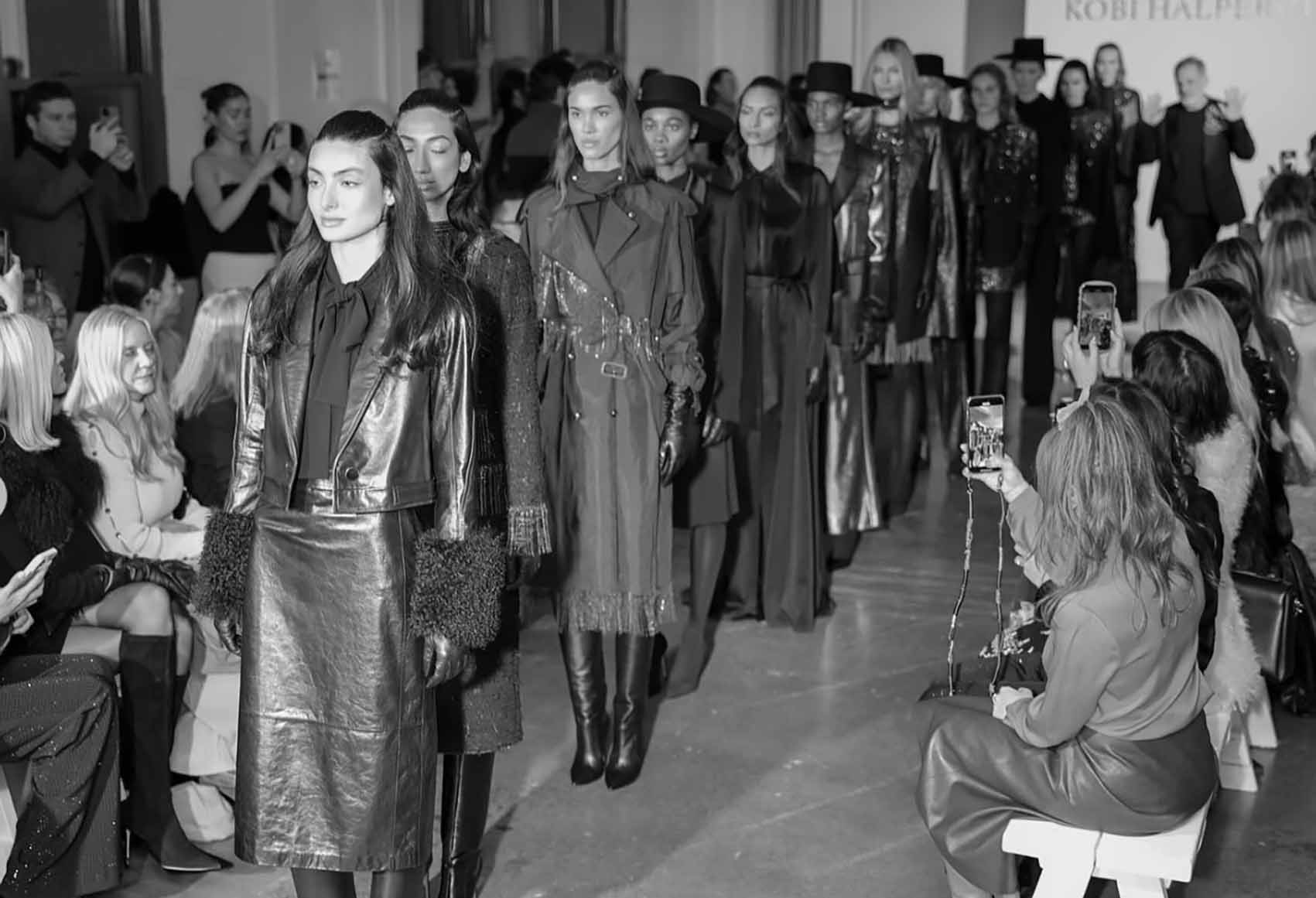
Kobi Halperin at Tel Aviv Fashion Week, 2025. Photo: Bat Hartman
Luxury Without Effort
The Kobi Halperin brand is identified with femininity, softness, detail, craftsmanship and accessible luxury. But when I ask him what luxury means to him, he returns to what does not try too hard. "Luxury, to me, is the thing that is effortless," he says. "It is the chic that is difficult to define. Money can make people lose their personal taste. The moment you try too hard, it takes something away from the look."
His luxury is not cold. It is not based on distance. It does not ask the customer to become someone else. It is connected to the past, to nostalgia, to home, to a sense of elegance that lives in the body and not only in the image. "We are not really at a stage where one can do something completely new," he says. "It is precisely the connection to the past, the nostalgic connection, that interests me."
Then he says one of the most beautiful sentences in our conversation: "A garment, for me, is a kind of protection. Something that makes you feel at home." In other words, Kobi Halperin does not design only dresses, blouses, jackets and trousers. He designs a feeling. A possibility of being in the world without apologizing. Elegant, feminine, strong, protected.

Ungaro, Paris and the French Legacy
Alongside the brand that bears his name, Halperin is in dialogue with an entirely different legacy, the French fashion house Ungaro. Founded in 1965 by Emanuel Ungaro, the house is associated with femininity, color, romance, Paris, sensuality and theatricality. Halperin does not see Ungaro and Kobi Halperin as two competing worlds. Quite the opposite.
"They are like good sisters who love each other," he says. "The handwriting is very similar. Everything Mr. Ungaro created, femininity, romance, Paris, those are things I am deeply connected to." And yet, there is a difference. At Kobi Halperin, the inspiration comes more deeply from the soul, from home, from the roots. At Ungaro, it can be more Parisian, more sensual, more dressy, sometimes closer to evening. But in both cases, the central point remains the same: memory and sensitivity to the woman of today.
"If Ungaro designed for the mistress," he says, "I design for a woman who can be whatever she wants, however she wants and whenever she wants." It is a sentence that marks the passage from an old masculine fantasy to contemporary femininity. For Halperin, the woman is not the object of a gaze. She is presence. She is choice. She owns the story.

"I Still Do Not Feel I Have Made It"
Halperin speaks about success carefully, almost suspiciously. When I ask whether there was a moment when he felt his language had been understood, he smiles. "We are still looking for it," he says of success. Then he becomes precise. "The doubt is always there," he says. "I still do not feel I have made it, and I hope I always feel that way, because that is what gives you the drive to continue."
And yet, there have been moments in which he allowed himself to feel. Returning to Israel, showing a collection here, was one of them. "To come back home and present a collection in Israel for the first time, there was something embracing about it," he says. "It was the most emotional moment." Alongside it, his recent show in Paris, at the opera, felt almost impossible for him to absorb. "It is the temple of fashion," he says. "I am still trying to process that it happened." But the recognition he seeks does not necessarily come through editors, magazines or Anna Wintour. It comes first through his customers.
"There was a choice, perhaps not a conscious one, that it would not happen through editors and magazines," he says. "That it would happen through my customers. That protects me and gives me confidence on this journey." There is something rare and compelling in that. An international designer who shows in Paris, works with American department stores and leads a brand under his own name, still seeks the embrace not through the system, but through the woman who wears him.

Israel as Home, Even After Thirty Years in New York
Kobi Halperin lives and works in the world, but Israel has not remained merely a biographical chapter. It is still the place from which everything happens. "I have been in New York for thirty years, and in fact, I live in Israel," he says. "I work in New York, but I live what happens here. I come home all the time. My closest friends are Israeli. From the moment I finished Shenkar, everything still happens from here."
When I tell him that I see in his dresses something that could speak to Israeli women too, even women who come from worlds of modesty, he does not resist. On the contrary. "You are absolutely right," he says. "In my eyes, modesty is sexy. I never had the need to rebel against the place I came from. I have a great deal of love and respect for it."
He speaks about the women of the community he came from as women of great elegance. Not as a cliché. Not as an external gaze. As someone who grew up there and knows the language from within. Alongside that, he also sees in Israeliness a practicality, a movement, a need for clothes that feel good, a life that is not lived only on a red carpet. "I take it as a compliment that you see Israeliness in my work," he says. "I took the best things from all the worlds around me."

After October 7, Fashion Took on Another Meaning
When the conversation reaches Israel, it inevitably reaches October 7 and the rise of antisemitism around the world. Halperin does not rush into slogans. He speaks carefully, with gravity, from the most personal place. "After October 7, it was very difficult for me to continue without stopping for a moment and asking what we do with all this weight," he says. "And also, as a father of two daughters, how do you explain dealing with fashion, something that can seem unimportant."
Precisely from that place, he says, came a renewed understanding of the profession. "I understood the meaning of fashion," he says. "In the simplest way, to bring beauty into a world that needs it more than ever. The world is not very beautiful right now." In the United States, in meetings with customers and employees in stores, he feels he has a way to tell the Israeli story differently. Not through shouting. Not through rage. Not through trying to convince by force.
"As Israelis, we have anger, and rightly so," he says. "But it is very hard to listen to you when you are shouting and angry." His choice is a different path. Through story. Through a garment. Through a human encounter. "I tell the inspiration behind the clothes, the story, without touching directly on the place I come from, but still speaking about it," he says. "In my eyes, it is a kind of mission." He knows there are people who will not like him simply because of who he is. Jewish. Israeli. A person who comes from that place. But he has no intention of hiding. "I have to remain true to myself," he says. "I am not going to hide it."
Within a fashion world that often hesitates before political complexity, Halperin chooses not to turn his identity into a weapon, but also not to set it aside. It is there. In the garment. In the story. In the way he stands before a woman and tries to remind her that there is still beauty in the world.

The Next Home of Kobi Halperin
After a decade of the brand that bears his name, Halperin is already looking further ahead. His goal is not only to dress the customer, but to be present in her life. "My goal is to be as involved as possible in the life of the customer," he says. "It begins, of course, with clothing, but it can become every possible category. The idea is to create a home."
The word home returns again and again. The home in Netanya. The religious home. The customer’s home. Home as a feeling inside a garment. Home as a brand. Home as something that can expand, but must never lose itself. And Israel? There, he admits, the heart works before business logic. "My desire to be meaningful in Israel does not come from a business place," he says. "It comes from the heart."

To a Young Designer, He Says: First, Learn
Halperin returns to Shenkar every year to work with students. Not to critique them, he says, but to give them something from the road. In a world in which young designers want to open a brand quickly, be seen quickly, succeed quickly, he offers a different kind of advice: do not skip the journey. "There is something connected to ego in the need to open your own business," he says. "It can happen and it should happen, but not at the beginning. You have to go through a certain road. To learn through other people’s mistakes."
And he adds: "You need to find the place where you can excel. Not everyone has to be good at everything. You need to find the thing you can do better than other people and focus on it." It is simple advice, almost unfashionable, but it sums up much of his philosophy. Less noise. More road. Less urgency to be everything. More precision in the place where you can truly be good.

"Being a Good Person, That Is What I Can Be Proud Of"
Toward the end of the conversation, I ask him what he would say to the young Kobi, the one who started at Shenkar. Before he answers himself, he asks to thank others. His parents. The people who believed in him. Those who pushed him forward. "First of all, I need to say thank you," he says. "There were many people who believed in that Kobi. Before I am proud of Kobi, I need to say thank you to all the people who supported me from the very beginning." And then, still, he manages to look at the journey. Not through prizes. Not through shows. Not through headlines. Through the person.
"I am proud of the road," he says. "It is hard for me to compliment myself on something connected to fashion, but I do need to compliment myself for remaining loyal to Kobi from Netanya. Kobi who learned from his father and from his education what it means to be a good person. That is what I try to preserve. If I can be proud of something, it is that. Fashion is secondary."
And perhaps that is the most precise ending to a conversation with Kobi Halperin. Because after New York, Paris, Ungaro, the CFDA, shows, customers, luxury, style and the world, he returns to the place from which he began. A child from Netanya. A religious home. Shabbat. A grandmother in heels. A father who taught simplicity and goodness. A mother who understood that a garment can be power. Perhaps that is why his clothes work. They do not try to escape the root. They grow from it.
The interview and photoshoot took place at Hotel 1935, part of the Adam Hotels chain.

מגזין אופנה – Fashion Israel
אי מייל: fashionisrael.nag@gmail.com
אינסטגרם: fashionisrael.mag@
וואטסאפ: 050-7368167
עורך ראשי: אפי אליסי
עורכת אופנה: shaniaqua@
Fashion Israel – הבית של האופנה הישראלית
אופנתי. חברתי. ישראלי.
חדש ב-Fashion Israel: מגזין אופנה דיגטילי – תוכלו לדפדף בהפקות אופנה המקוריות שלנו. לצפיה בגרסת מחשב בלבד!
מגזין אופנה מוביל בישראל. אופנה ישראלית זה אנחנו!
לעוד כתבות אופנה לחצו כאן
לעוד חדשות האופנה לחצו כאן